

Vulnerability Management: Is CVSS Alone Enough? How to Identify Risks That Are Actually Exploitable
Vulnerability management can no longer rely only on CVSS scores or CVE counts. Real risk depends on whether a vulnerable asset is running, externally reachable, and connected to privilege escalation or lateral movement paths. WERANA Veluna combines scan results with EPSS, KEV, exposure, and runtime usage context so security teams can focus on exploitable risks that require immediate action.
In 2026, security operations teams are struggling to respond effectively to the overwhelming volume of vulnerability alerts generated every day. Simply eliminating CVEs with high CVSS scores has clear limitations when it comes to stopping real threats, and this approach can lead to inefficient use of security resources.
As a result, organizations must examine the structural gaps in traditional vulnerability management and rethink how they prioritize risks in order to maintain business continuity.
The Limits of Metric-Based Vulnerability Management: Why CVSS and CVE Tracking Are Not Enough
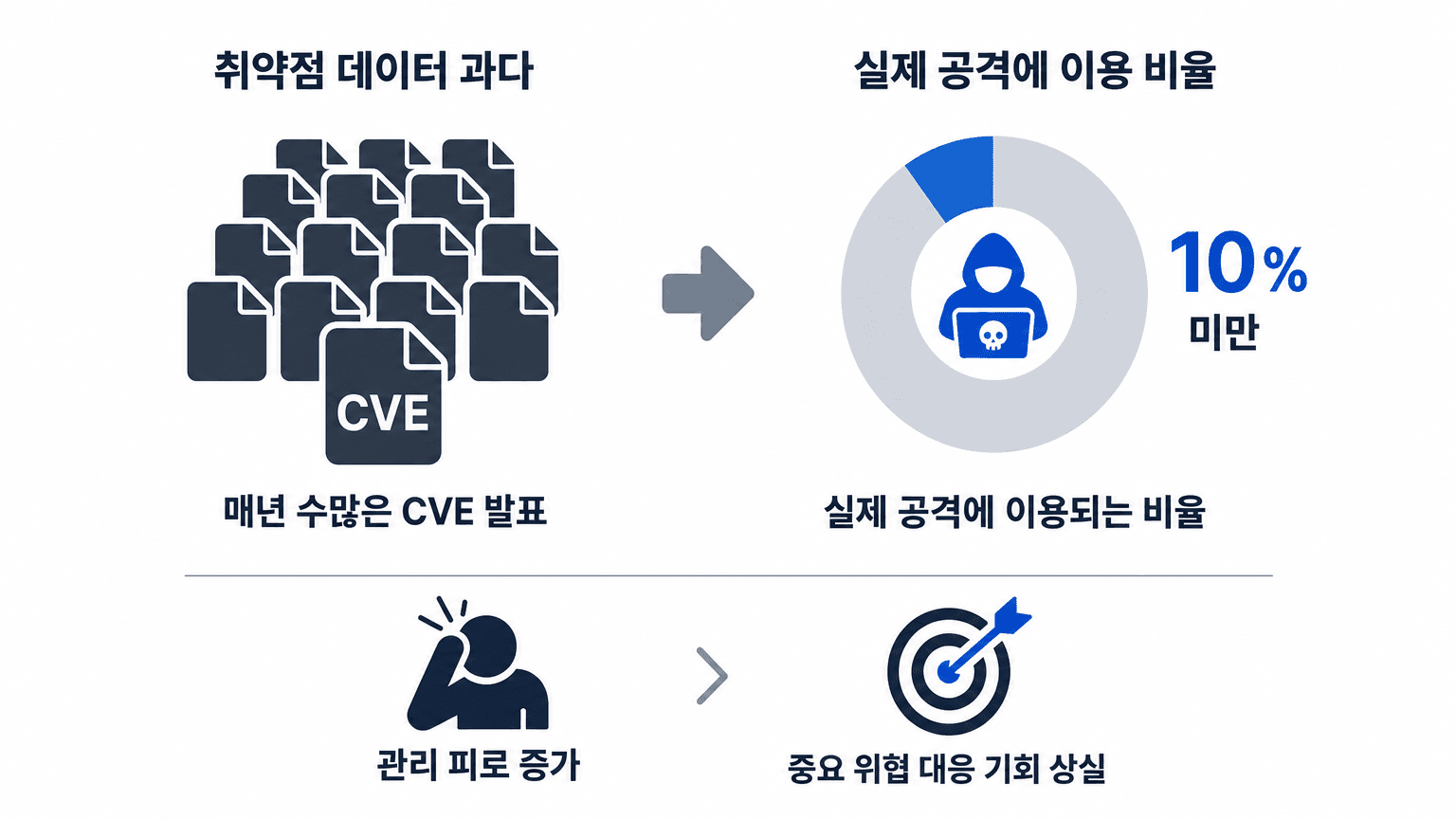
The Flood of Vulnerability Data and the Limits of Resource Management
Among the massive volume of CVE data published every year, less than 10% is known to be used in actual attacks. Many organizations rely on CVSS scores to remediate high-severity vulnerabilities first. However, this does not always align with the threats that attackers are actually able to weaponize.
This approach can cause security teams to spend time and effort on vulnerabilities with relatively low real-world risk, leading to vulnerability management fatigue. More importantly, it can cause teams to miss the opportunity to respond to threats that truly matter.
The Complexity of the 2026 Security Landscape and the Changing Nature of Threats
As supply chain attacks and multi-stage attack paths continue to increase, security threats have become far more sophisticated than before. CVSS, as a static scoring system, has a technical limitation: it does not fully reflect the dynamic nature of exploitability in real time.
Therefore, vulnerability security strategies must move away from the idea of eliminating every weakness and shift toward a risk-based model that considers actual exploitability and business impact. Prioritizing vulnerabilities based only on scores, without environmental context, is no longer an effective security strategy.
Data-Driven Decision-Making: Combining EPSS and KEV
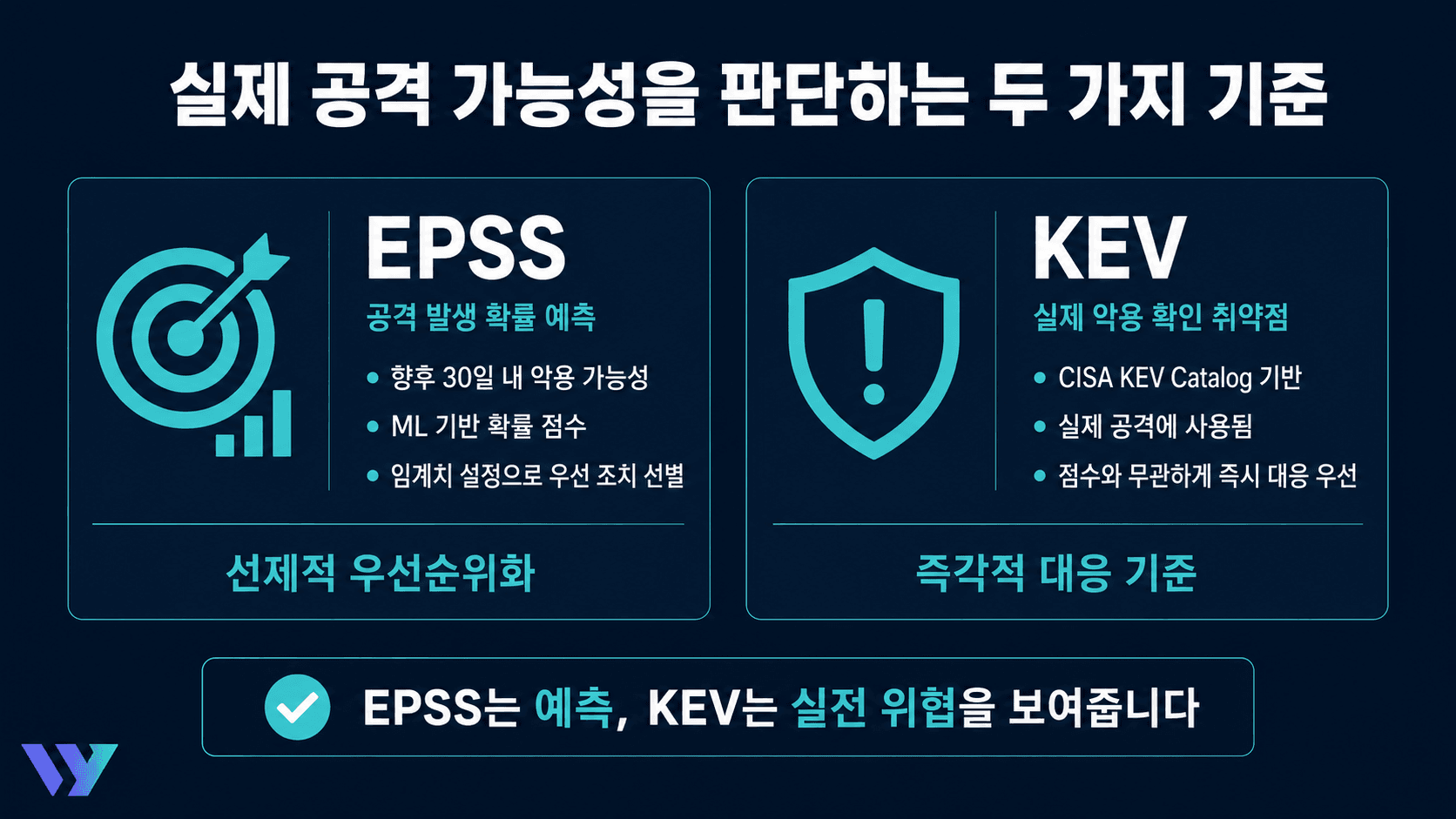
Using EPSS to Predict the Likelihood of Exploitation
EPSS uses machine learning models to quantify the probability that a specific vulnerability will be exploited in the next 30 days. This predictive metric helps address the limitations of static severity scoring and enables security operators to identify potential threats in advance.
To allocate resources efficiently, organizations should define EPSS thresholds based on their own risk tolerance. This provides an objective basis for selecting which CVEs require urgent action among a large number of vulnerabilities.
Using KEV to Respond Immediately to Real-World Threats
The KEV catalog, managed by CISA, contains vulnerabilities that have been confirmed to be actively exploited by attackers. Vulnerabilities listed in KEV should be treated as existing threats regardless of their technical severity score, making them strong practical candidates for immediate patching.
By combining threat intelligence with vulnerability management processes, organizations can reset security priorities based on real-world attack data and improve the accuracy of their response.
| Metric Type | Key Characteristic | Practical Use |
|---|---|---|
| CVSS | Technical severity, such as Critical, High, Medium, or Low | Used as a baseline filter for general risk level |
| EPSS | Predicts the probability of exploitation within the next 30 days | Used to prioritize patches against likely future threats |
| KEV | Catalog of vulnerabilities confirmed to be exploited in the wild | Treated as the highest-priority list for immediate action |
Calculating Real Risk Through Contextual Analysis
Identifying Real Vulnerabilities Through Runtime Analysis
Even if a vulnerable library exists in an environment, it may not pose a real threat if the affected code is not loaded into memory or executed. Runtime analysis helps identify which code is actually invoked while services are running, reducing unnecessary remediation work.
By applying this contextual analysis, organizations can significantly reduce avoidable patching efforts. This also improves collaboration efficiency between security teams and development teams.
Visualizing External Exposure and Attack Paths
Whether an asset is exposed to the internet and where it sits within the internal network are critical factors that determine the likelihood of a successful attack. Vulnerabilities located along privilege escalation paths or lateral movement routes can have a significant business impact.
Therefore, organizations should move beyond simple scan results and build defense strategies by visualizing attack paths and connecting them with asset criticality. Blocking critical paths in advance is now a core strategy in modern vulnerability security.
Improving Security Decision-Making with WERANA Veluna
Unifying Threat Intelligence and Visibility
WERANA Veluna provides a framework for consolidating fragmented security indicators and analyzing threats from a consistent perspective. By connecting traditional vulnerability scan data with EPSS, KEV, and global threat intelligence in real time, Veluna calculates a risk index for each vulnerability.
This unified visualization enables security teams to make decisions based on objective data. It also provides strong evidence when explaining to executives why certain patches must be prioritized.
Maximizing Operational Efficiency by Selecting Real Risks
The core value of WERANA Veluna lies in its ability to identify the top 1% of risks with the highest likelihood of real exploitation among countless alerts. By combining runtime usage analysis with external accessibility data, Veluna helps teams identify threats that are not merely theoretical, but realistically exploitable.
Security operators can reduce the time required for decision-making and strengthen the overall resilience of the organization. Building an effective vulnerability management system is no longer optional; it is essential for organizational survival.
| Analysis Stage | Role of WERANA Veluna | Expected Outcome |
|---|---|---|
| Threat Intelligence | Connects EPSS and KEV in real time and calculates threat scores | Reflects external threat trends in real time |
| Environmental Context | Analyzes runtime usage and external exposure | Identifies real risks specific to the organization’s environment |
| Business Value | Connects critical assets with attack paths | Prioritizes remediation to reduce business impact |
Conclusion: Strengthening Security Through Strategic Focus
Modern security requires organizations to move away from the habit of simply clearing CVE lists and instead focus on understanding the real context behind each threat.
By analyzing the actual risk hidden behind CVSS scores and using an intelligent platform such as WERANA Veluna, organizations can allocate limited resources more effectively. Data-driven and context-aware insight represents the direction security professionals must move toward in 2026.