

Kubernetes Security: Why Runtime Security Matters After Deployment
Kubernetes security is not complete with image scanning, RBAC, and pod security settings alone. After deployment, real behaviors occur inside running pods and containers, including process execution, file access, network traffic, privilege escalation attempts, and abnormal outbound connections. WERANA Veluna uses runtime context to help identify real threats and prioritize response.
Following the Shift-Left strategy, organizations often strengthen security before deployment by completing image vulnerability scanning and RBAC, or Role-Based Access Control, configuration. However, security incidents still frequently occur in real production environments.
This means that static configuration checks alone cannot fully block runtime drift or dynamic attack payloads that occur inside running containers. Therefore, modern cloud-native security must move beyond verifying fixed configurations and focus on detecting and blocking runtime threats that occur in real time at the kernel level.
The Limits of Pre-Deployment, Configuration-Centric Security and What Static Security Misses
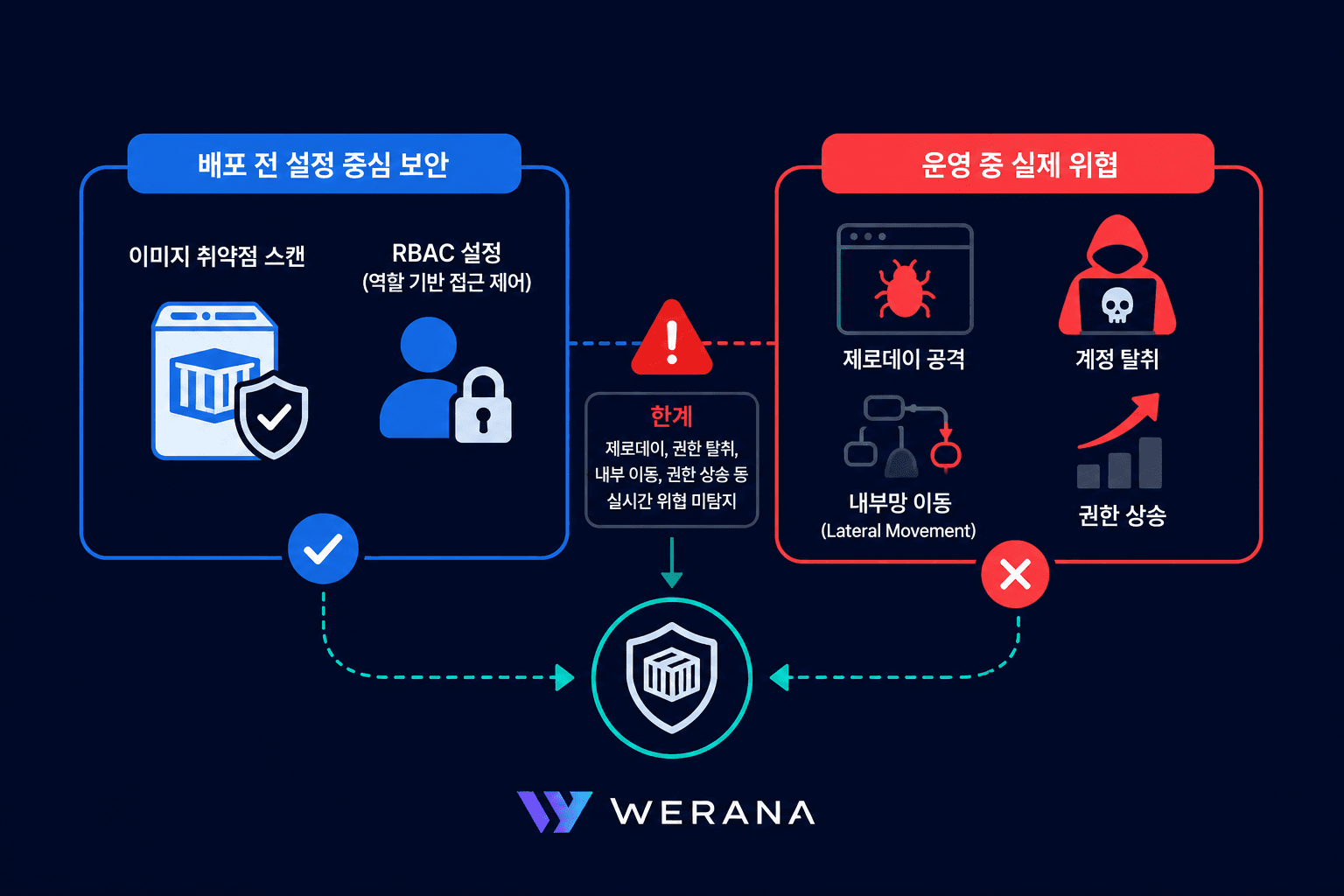
Image scanning is highly effective at identifying known CVEs, or Common Vulnerabilities and Exposures. However, it is defenseless against zero-day vulnerabilities disclosed after deployment. For example, a remote code execution, or RCE, vulnerability discovered later in a specific library can create a serious security gap inside a pod that has already passed validation.
RBAC also has limitations. It can restrict the scope of access permissions, but it cannot monitor lateral movement using a compromised account or privilege escalation attempts in real time. In the end, true container security is achieved only when static vulnerability management and dynamic threat defense are integrated into a single pipeline.
Recent Advanced Persistent Threats, or APTs, increasingly favor post-deploy attack techniques to bypass security validation. In this approach, an image is initially deployed as normal to avoid detection. Then, at runtime, it downloads malicious scripts from an external server or performs fileless attacks that operate only in memory.
These behaviors cannot be detected through static configuration values alone. If security teams cannot track, in real time, how an attacker gains a shell and executes administrative tools, the entire infrastructure can be compromised rapidly. In 2026, security strategy must move beyond integrity at deployment time and prioritize visibility at execution time.
Abnormal Behaviors to Watch in Runtime Environments
The core of pod security is the ability to immediately detect abnormal process execution patterns. If network tools such as curl, wget, or nc, or shell processes such as sh and bash, suddenly appear inside a container running a web service, this is a strong indicator of compromise. In a normal application runtime, there is usually no reason for these tools to execute.
The practical goal of runtime defense is also to detect and block abnormal read or write attempts against sensitive files such as /etc/shadow, as well as kernel module manipulation, in real time.
From a workload security perspective, abnormal outbound traffic must be monitored closely. If an internal workload sends large volumes of data to an undefined external IP address or to a C2, or command-and-control, server in a specific country, it may indicate data exfiltration or cryptojacking.
In particular, correlating outbound connections with the process ID, or PID, and parent process information provides decisive clues for identifying the origin of an attack and preventing further spread.
| Monitoring Area | Example of Normal Behavior | Example of Abnormal Behavior, or Runtime Threat |
|---|---|---|
| Process Execution | Only defined binaries, such as Java or Go, are executed | Unexpected execution of administrative tools such as sh, curl, or wget |
| File System Access | Only designated log and temporary directories are used | Access to sensitive paths such as /etc/shadow or /root/.ssh |
| Network Connections | Allowed communication between microservices, or East-West traffic | Connection attempts to external C2 servers or abnormal ports |
| Privileges and Spread | Resources are used only within the assigned namespace | Host file system mounting or container escape attempts |
Attempts to break out of container isolation, access the host node, or expand attacks to adjacent pods can lead to the collapse of the entire cluster. Organizations should build an automated response system that visualizes network topology in real time and immediately quarantines workloads where abnormal behavior is detected.
This immediate response can significantly reduce attacker dwell time and drastically limit the scale of damage.
Improving Log Analysis Efficiency with the Power of Context
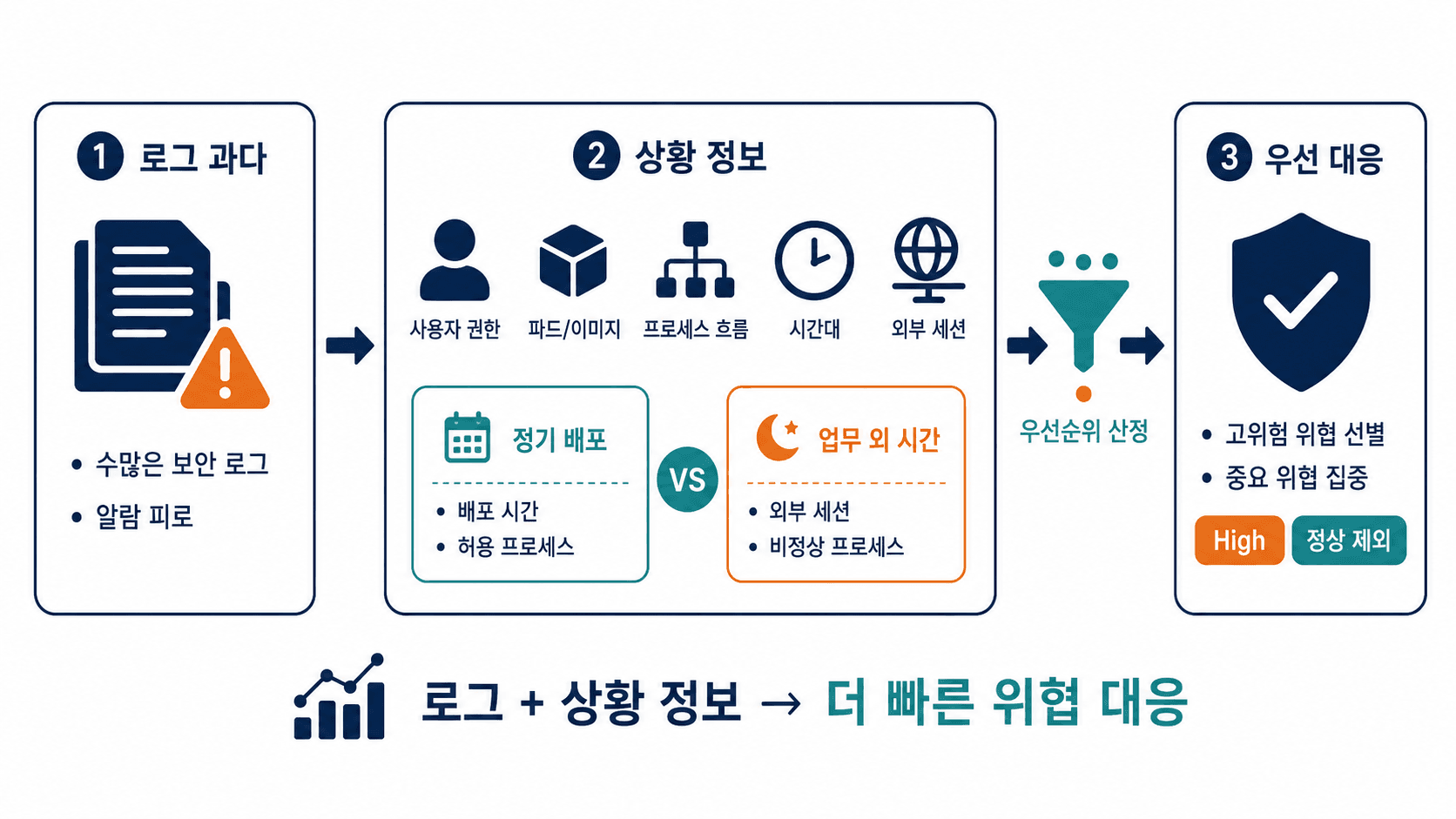
In complex microservices architectures, or MSA environments, tens of thousands of security logs can be generated every second. This creates serious alert fatigue for security teams.
A simple list of event logs is not enough to determine whether an event is a real attack or a temporary operational error. One of the biggest weaknesses in modern security operations is that teams become buried under massive volumes of data and miss critical threat signals.
Therefore, security systems in 2026 must go beyond simple log collection and provide context that explains what happened before and after an event.
Runtime context is essential for effective threat response. Security teams need integrated data that shows which user permission was involved, which pod image version was affected, and through which process tree a specific behavior occurred.
For example, the same file access event has a completely different risk level depending on whether it occurred during a scheduled deployment process or through an external session outside business hours. By automatically calculating threat priority based on this context, security teams can focus their limited resources on truly high-risk threats.
Building an Intelligent Runtime Defense System with WERANA Veluna
WERANA Veluna is an integrated security platform that provides deep visibility across Kubernetes and container environments. It visualizes the connection status of all assets in a cluster through real-time topology, allowing security teams to quickly identify security blind spots.
In particular, Veluna correlates pre-deployment vulnerability scan results with real-time runtime behavior data. This correlation analysis significantly reduces false positives and helps teams respond first to threats with a high likelihood of real exploitation.
Because containers are ephemeral, collecting forensic data after an incident is extremely difficult. Veluna preserves all process execution records and network connection histories in a timeline format, enabling precise attack path analysis even after a container has been deleted.
This also helps automatically generate audit evidence required for ISMS-P certification or compliance with public cloud security guidelines. As a result, adopting Veluna becomes a strategic choice for continuously proving infrastructure security and improving incident response capabilities.
Strategic Advice for Real-Time Threat Response
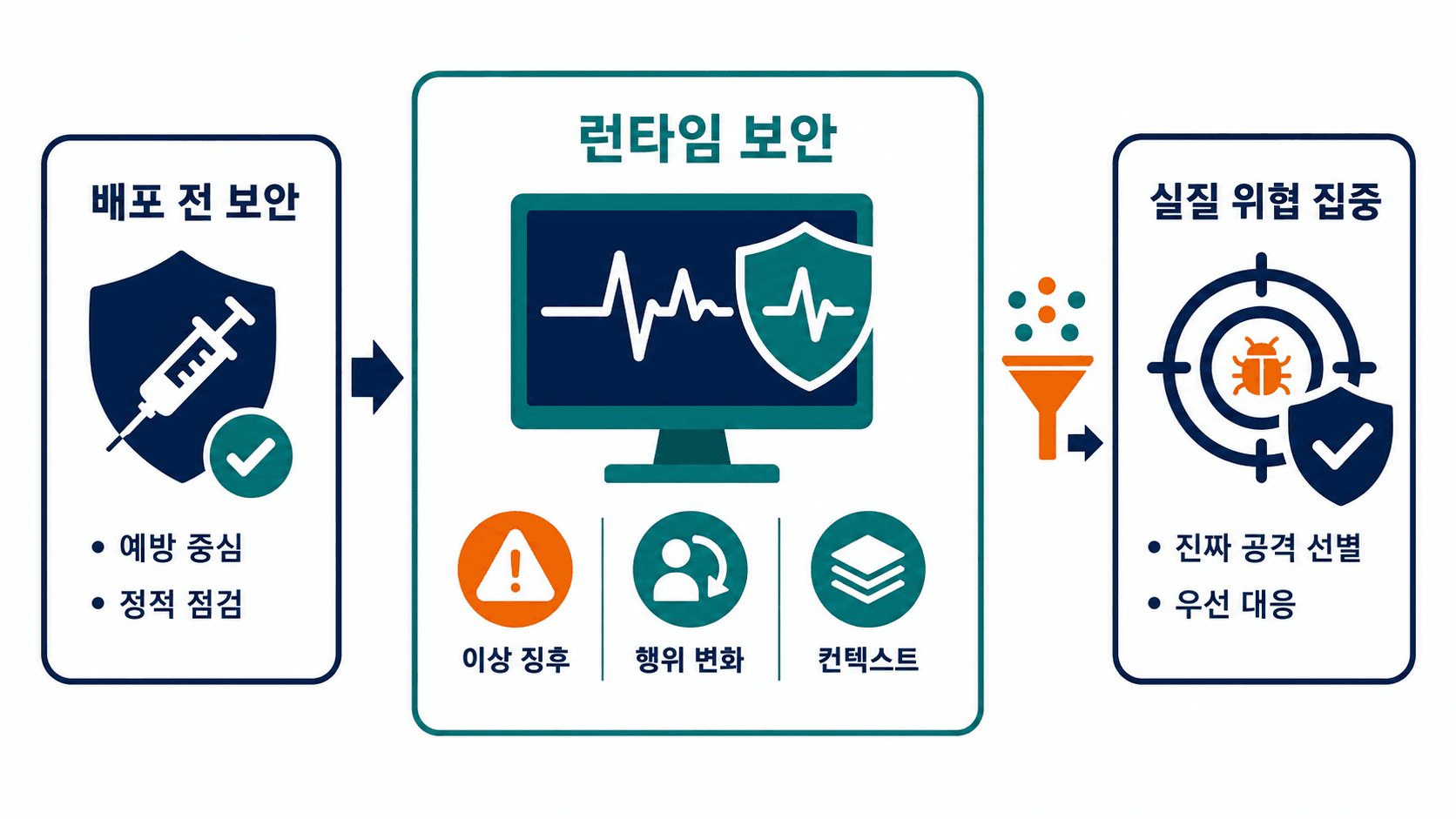
If pre-deployment security is like a vaccine that helps prevent disease, runtime security is like intensive care monitoring that continuously checks health status and performs emergency treatment in real time.
Perfect configuration does not exist. Organizations must also have the ability to detect and analyze abnormal signals in constantly changing runtime environments. If subtle behavioral changes inside infrastructure cannot be detected, even the strongest firewall can become ineffective.
Ultimately, the key strategy is to make invisible dynamic threats visible and focus on real threats based on rich context. The ability to distinguish real attacks from countless security signals will become a core competency for DevSecOps engineers in 2026.
This systematic approach is one of the most reliable ways to protect critical IT assets and business continuity from increasingly sophisticated cyber threats.